

In today's increasingly digital world, conducting transactions and exchanging information electronically has become commonplace. While this shift offers convenience and environmental benefits, it also raises crucial questions about security and trust. Digital signatures provide a robust solution to these concerns, offering assurances about the origin, authenticity, and integrity of digital documents. This article delves into the fundamental aspects of what is a digital signature, exploring its underlying technologies and the critical role it plays in securing online interactions.
Understanding What a Digital Signature Is
At its core, a digital signature is an electronic, encrypted stamp of authentication applied to digital information. This information can include email messages, macros, or electronic documents. The primary purpose of a digital signature is to confirm that the information originated from a specific signer and that its content has not been altered since it was signed. This is analogous to a handwritten signature on a physical document, but with significantly enhanced security and verifiable proof.
The concept of a digital signature on a document is vital for maintaining trust in digital workflows. When you send a digitally signed document, you are essentially providing irrefutable proof of your identity and the document's unaltered state.
Signing Certificate and Certificate Authority Explained
To create a digital signature, specialized tools are required, primarily a signing certificate and an understanding of Certificate Authorities (CAs).
What is a Signing Certificate?
A signing certificate, often referred to as a what is a digital signature certificate (dsc), is an electronic credential that proves the identity of the signer. When you digitally sign a document or macro, your certificate and public key are transmitted along with the signed information. Certificates act as digital identification, much like a driver's license, and are issued by trusted third parties known as Certificate Authorities.
Certificates typically have a validity period, often a year. After this period, the signer must renew or obtain a new signing certificate to continue establishing their identity reliably. Understanding the role of a digital signature certificate is fundamental to grasping how digital signatures function.

The Role of the Certificate Authority (CA)
A Certificate Authority (CA) is an entity that functions similarly to a notary public in the digital realm. Its responsibilities include issuing digital certificates, digitally signing these certificates to verify their authenticity and validity, and maintaining records of certificates that have been revoked or have expired. This role is critical in building trust within the Public Key Infrastructure (PKI) ecosystem.
Assurances Provided by Digital Signatures
Digital signatures offer several key assurances that are essential for secure digital transactions:
Authenticity
Authenticity confirms that the signer is indeed who they claim to be. The digital signature cryptographically links the signature to the signer's verified identity through their certificate.
Integrity
Integrity ensures that the content of the digital information has not been changed or tampered with since it was digitally signed. Any modification, no matter how small, would invalidate the signature.
When considering what is a digital signature on a document, integrity is one of its most powerful features, guaranteeing that the recipient sees the exact information the sender intended.
Non-repudiation
Non-repudiation provides proof that the signed content originated from the specified signer. This means the signer cannot later deny their association with the signed content. This is a critical legal and business safeguard.
Digital Signatures vs. Electronic Signatures
It's important to distinguish digital signatures from broader electronic signatures (e-signatures). Electronic signatures encompass any electronic process used to indicate acceptance of a document or transaction. While digital signatures are a type of electronic signature, they are the most secure and legally robust form available.
Digital signatures leverage PKI certificates and CAs for strong identity authentication and document integrity. Other less secure e-signature types might rely on simpler authentication methods like email verification or user IDs. This distinction is crucial for understanding the legal and security implications of different signing methods.
How Digital Signatures Work
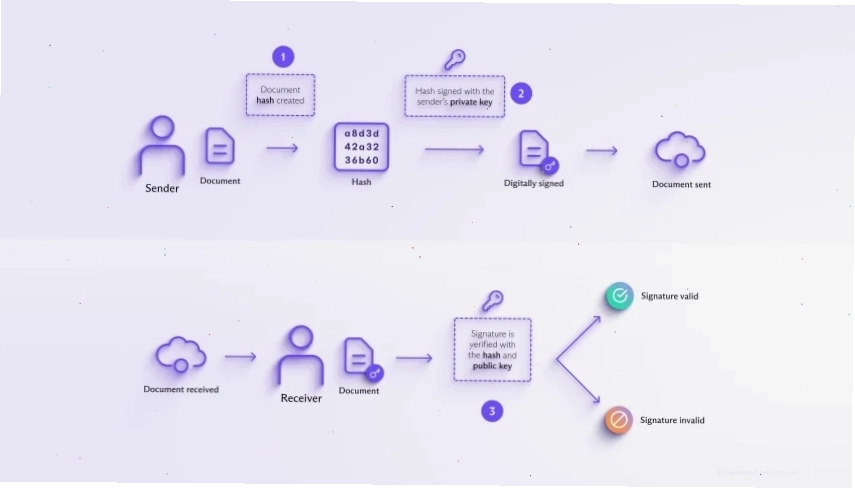
The process of creating and verifying a digital signature involves a sophisticated cryptographic mechanism:
- Hashing: A unique digital fingerprint, known as a hash, is created from the document's content.
- Encryption: This hash is then encrypted using the signer's private key. This encrypted hash forms the digital signature.
- Transmission: The original document, the digital signature, and the signer's public key (contained within their certificate) are sent to the recipient.
- Verification: The recipient's software uses the signer's public key to decrypt the hash. It then independently creates a hash from the received document. If the two hashes match, the signature is valid, confirming authenticity and integrity.
The use of a digital signature certificate is integral to this verification process, as it provides the necessary public key and trusted identity information.
Legal Validity and Notarization
In many countries, including the United States, digital signatures are legally binding. Furthermore, digital signatures in Microsoft Office applications like Word and Excel, when time-stamped by a secure server, can carry the validity of a notarization under certain circumstances. This strengthens their role in formal agreements and official documentation.
For these assurances to hold, the digital signature must be valid, the associated certificate must be current (not expired), and the publisher (signer) must be trusted. Importantly, signed documents with a valid timestamp are considered to have valid signatures, irrespective of the signing certificate's age, reinforcing the security provided by time-stamping services.

Conclusion: Securing Your Digital Future
Understanding what is a digital signature is no longer optional in our interconnected world. It is a fundamental tool for ensuring trust, security, and legal validity in digital communications and transactions. By leveraging PKI, signing certificates, and the robust cryptographic principles behind them, digital signatures provide unparalleled assurances of authenticity, integrity, and non-repudiation. Implementing digital signatures is a critical step for individuals and organizations looking to protect sensitive information and streamline digital workflows securely. Embrace the power of digital signatures to safeguard your digital interactions and build lasting trust online.